

Automation & Script Development
UserTalk suites and scheduled agents
What this includes →Script Meridian is where people who write UserTalk, run Frontier and Radio UserLand, and maintain the systems built on them come to compare notes — and a small studio that keeps those systems in production for the organisations still depending on them.
 Press / anywhere to search the site.
Each engagement is scoped in writing before it starts, priced as a fixed band, and delivered with the source you can read and keep.
UserTalk suites and scheduled agents
What this includes →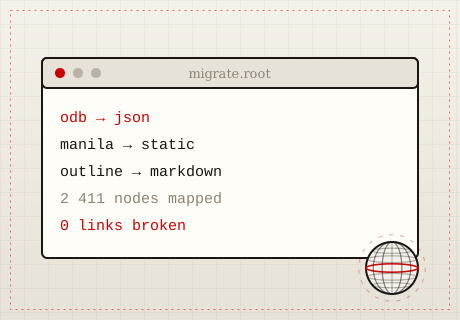
ODB, Manila and Conversant, moved safely
What this includes →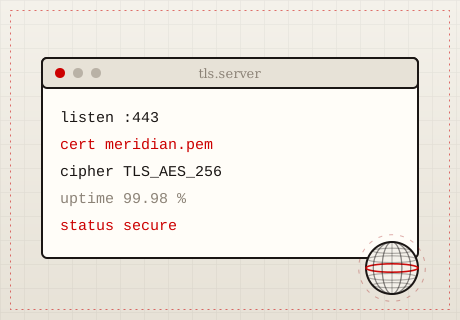
https, monitoring and backups
What this includes →
Cohort courses for scripters
What this includes →
Profiling and a written report
What this includes →Kept in the original reverse-chronological form, exactly as it was published on the day — now with every reference wired to the catalogue.
TLS 0.3.1 has been released. It is primarily a bug-fix release that repairs several problems in the secure server.
TLS stands for Transport Layer Security. It includes SSL and is the standard that superseded it. Macrobyte’s implementation lets Frontier and Radio serve https and act as a secure client. See our walkthrough in Running a Secure Server with TLS.
John VanDyk has released a new Frontier and Radio suite, The Tracer Suite. It shows the scripts that are executing, in the order they were invoked, so you can see what is actually going on.
Macrobyte Resources has released Conversant, the groupware and CMS platform Script Meridian itself runs on. The story is told in From Manila to Conversant.
A new essay explains the optimal methods for building large strings in UserTalk, including why those methods are the fastest.
In order to optimise this process as much as possible, there are two things the scripter needs to remember: avoid copying large strings whenever possible, and trigger the secret in-place append.— Optimal String Concatenation
Eric Soroos: RFC — Port Forwarding Tool. “On OS X, Frontier runs as a user process, not as root. Therefore it cannot bind to ports below 1024. We have been using port forwarding to map low-numbered ports to high ones.”
Jim Byrne: CommentIt 2.6.6 for Manila adds new features.
Tallent Communications Group has updated the ODBC Extension. The new version works on Mac OS X and with Radio UserLand.
André Radke: PostgreSQL Extension for Frontier.
Macrobyte Resources: a secure server for Frontier and Radio is in development. “Early pre-release versions have already been tested successfully.”
Formz, by Macrobyte Resources, is a suite of scripts that simplifies the creation, manipulation and rendering of HTML forms.
Greg Pierce’s pySlice implements string and list slicing the same way Python does.
Brent Simmons released a contextual menu plugin that runs scripts from any application supporting contextual menus.
Six detailed pieces on the language, the database, the protocols and the history — written for people who have to make this work on a Tuesday.
The language behind Frontier: verbs, tables, threads and semicolons.
Read the article →
Why in-place append beats copying, and how to assemble megabyte strings quickly.
Read the article →
Putting Frontier and Radio behind https, from certificate to cipher suite.
Read the article →Frontier shipped in 1992 and Radio UserLand in 2001. A quarter of a century later there are still newsrooms, universities and engineering teams whose publishing pipeline, build automation or internal directory runs on an object database and a few thousand lines of UserTalk that someone wrote carefully and nobody has needed to rewrite.
The risk is not the software. It is that the person who understood it retired. We read the code, write down what it does, and give you the choice of keeping it, modernising it, or moving off it on your own schedule.
How we work
No. Roughly half of our work is the bridge between an old scripted system and something current — a REST service, a static site generator, a warehouse, a modern CI runner. We are equally comfortable in UserTalk, Python, JavaScript and shell.
Each service page carries an indicative band. Audits start at a fixed fee because the scope is known; migrations are quoted after a paid discovery week, because the honest answer before that is a guess. We do not bill for the first conversation.
That is the preferred shape. Every engagement ends with a handover session and written documentation, and the workshops exist precisely so the knowledge does not leave with us.
Yes — quieter than 2002, but active. Traffic is a few dozen messages a month, mostly operational questions and release notes. Joining is free and takes one form.