
Five engagements, scoped in writing
Every one of them starts with a conversation that costs nothing, produces a written scope before any invoice, and ends with you owning the source and the documentation outright. No retainers you cannot leave.
Automation & Script Development
Most of what a scripted system does well is repetition: assemble the nightly bundle, reconcile two directories, publish the catalogue, mail the exceptions to a human. We write that layer properly — with error handling, logging, a dry-run mode and tests — so it stops being the thing that breaks silently on a bank holiday.
- Discovery of the current manual process, written up as a sequence you can check
- A UserTalk suite (or Python/Node service, where that is the better home) with a documented public verb table
- Structured logging to a file and to the object database, with retention you choose
- Dry-run and verbose modes so an operator can see what would happen before it does
Legacy Migration
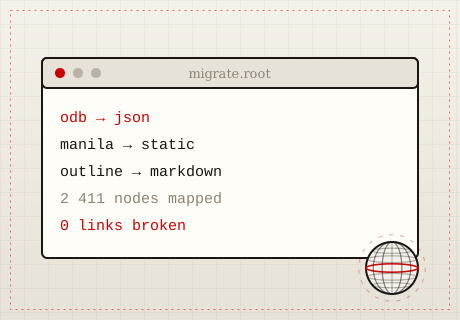
Migration work fails when it starts with the destination. We start with an inventory: what is in the database, what is actually referenced, what has not been touched since 2009, and what has a legal reason to survive. Only then is a target worth choosing.
- A full inventory of the object database: tables, scripts, outlines, binaries and orphans
- A reference map showing what calls what, so dead weight can be identified with evidence
- Content extraction to open formats — JSON, Markdown, CSV — with encodings normalised
- URL preservation: every published address either survives or gets a permanent redirect
Secure Hosting & TLS
A server built in 2002 can serve 2026 traffic safely, but not on its own terms. It needs a termination layer that speaks current TLS, a certificate that renews itself, headers the original author never had to think about, and a backup that has actually been restored at least once.
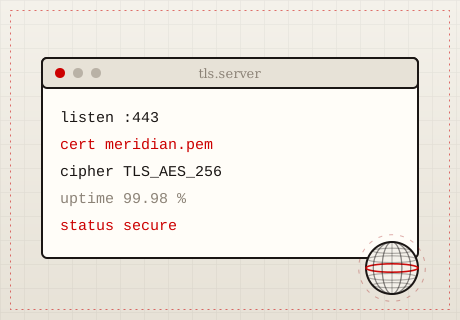
- TLS termination with automated certificate renewal and modern cipher policy
- Security headers: HSTS, a content security policy, frame and MIME protections
- Port-forwarding or reverse-proxy configuration so the runtime stays unprivileged
- Uptime and certificate-expiry monitoring with alerting to your channel of choice
Training & Workshops
The most expensive line in a legacy budget is not the consultancy — it is having nobody in-house who can touch the thing. Four half-days, twelve seats, and your people leave having shipped a working suite into your own environment.
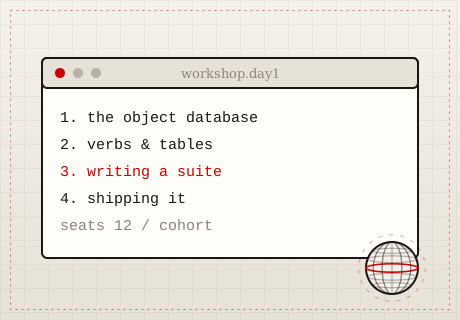
- Day one: the object database — addressing, persistence, tables and the root
- Day two: verbs, scripts, threads and error handling, written from scratch
- Day three: the web framework, templates, and how a request becomes a page
- Day four: packaging, deployment, monitoring and handing work to the next person
Code Audit & Optimisation
A fixed-scope, fixed-price read of your system. We profile it under realistic load, find where the time and memory actually go, fix the worst of it, and hand you a report that ranks everything else by effort against payoff.
- Profiling under production-like load, not synthetic benchmarks
- String-handling review — the single most common source of avoidable cost in UserTalk
- Memory growth analysis across a long-running process, with charts
- Database access patterns: repeated traversals, uncached lookups, unnecessary copies
Automation & Script Development
Custom UserTalk suites, scheduled agents and the glue between old systems and new ones.
Most of what a scripted system does well is repetition: assemble the nightly bundle, reconcile two directories, publish the catalogue, mail the exceptions to a human. We write that layer properly — with error handling, logging, a dry-run mode and tests — so it stops being the thing that breaks silently on a bank holiday.
What the engagement includes
- Discovery of the current manual process, written up as a sequence you can check
- A UserTalk suite (or Python/Node service, where that is the better home) with a documented public verb table
- Structured logging to a file and to the object database, with retention you choose
- Dry-run and verbose modes so an operator can see what would happen before it does
- Scheduling via Frontier's agents, cron or your existing runner — whichever you already monitor
- A rollback path for every write the automation performs
- Unit coverage for the pure logic and a smoke test for the end-to-end path
A good fit when
You have a process that a person performs by hand every day or week, it is well understood, and the cost of it going wrong is real.
Probably not a fit when
The process is still being argued about internally. Automating a decision nobody has made produces a faster argument, not a better one.

You receive
- Source in your repository, commented
- A runbook for operators
- A handover session, recorded
- Thirty days of post-launch support
from £4,800 per suite
Typical lead time: 3–6 weeks
You receive
- Inventory and reference map
- Extracted content in open formats
- Redirect map, tested
- Cutover plan and rollback plan
- Post-cutover diff report
from £12,000 per system
Typical lead time: 6–14 weeks
Legacy Migration
Move an object database, a Manila site or a Conversant community into a maintainable form.
Migration work fails when it starts with the destination. We start with an inventory: what is in the database, what is actually referenced, what has not been touched since 2009, and what has a legal reason to survive. Only then is a target worth choosing.
What the engagement includes
- A full inventory of the object database: tables, scripts, outlines, binaries and orphans
- A reference map showing what calls what, so dead weight can be identified with evidence
- Content extraction to open formats — JSON, Markdown, CSV — with encodings normalised
- URL preservation: every published address either survives or gets a permanent redirect
- Target options with honest trade-offs: static site, headless CMS, database-backed app, or stay put
- Phased cutover with a parallel-run period, never a single weekend switch
- A verification harness that diffs old and new output page by page
A good fit when
The system holds content or logic you cannot lose, and the people who built it are no longer available to explain it.
Probably not a fit when
You want a like-for-like rewrite in a fashionable framework by a fixed date. That is a rebuild, and it needs a product owner more than it needs us.
Secure Hosting & TLS
Run Frontier or Radio behind modern https, with monitoring, backups and someone on call.
A server built in 2002 can serve 2026 traffic safely, but not on its own terms. It needs a termination layer that speaks current TLS, a certificate that renews itself, headers the original author never had to think about, and a backup that has actually been restored at least once.
What the engagement includes
- TLS termination with automated certificate renewal and modern cipher policy
- Security headers: HSTS, a content security policy, frame and MIME protections
- Port-forwarding or reverse-proxy configuration so the runtime stays unprivileged
- Uptime and certificate-expiry monitoring with alerting to your channel of choice
- Nightly encrypted backups of the object database, with a quarterly restore drill
- Log shipping and retention that matches your policy, not ours
- A documented escalation path with a named human
A good fit when
A production system is reachable from the public internet and you would rather not find out about the expired certificate from a customer.
Probably not a fit when
You need a regulated hosting environment with formal certification. We will say so early and point you at people who hold it.
You receive
- Hardened configuration in version control
- Monitoring dashboard access
- Quarterly restore-drill report
- Monthly uptime and incident summary
from £340 per month
Typical lead time: 1–2 weeks to onboard
You receive
- Four half-day sessions, live
- Exercise repository
- Recordings and notes
- Follow-up clinic
- Certificates of completion
£2,400 per cohort of 12
Typical lead time: scheduled monthly
Training & Workshops
Cohort workshops that leave your team able to read, change and ship the system themselves.
The most expensive line in a legacy budget is not the consultancy — it is having nobody in-house who can touch the thing. Four half-days, twelve seats, and your people leave having shipped a working suite into your own environment.
What the engagement includes
- Day one: the object database — addressing, persistence, tables and the root
- Day two: verbs, scripts, threads and error handling, written from scratch
- Day three: the web framework, templates, and how a request becomes a page
- Day four: packaging, deployment, monitoring and handing work to the next person
- A private exercise repository your team keeps afterwards
- Recordings and annotated transcripts of every session
- One follow-up clinic, six weeks later, on your real code
A good fit when
You have two or more engineers who will own this system and currently learn it by reading other people's commits.
Probably not a fit when
You want a one-hour overview for a leadership audience. We would rather write you a two-page brief than sell you a workshop.
Code Audit & Optimisation
Profiling, string and memory work, and a written report you can act on without us.
A fixed-scope, fixed-price read of your system. We profile it under realistic load, find where the time and memory actually go, fix the worst of it, and hand you a report that ranks everything else by effort against payoff.
What the engagement includes
- Profiling under production-like load, not synthetic benchmarks
- String-handling review — the single most common source of avoidable cost in UserTalk
- Memory growth analysis across a long-running process, with charts
- Database access patterns: repeated traversals, uncached lookups, unnecessary copies
- Error handling and failure-mode review: what happens when the disk fills
- Security read: input handling, authentication paths, secrets in the database
- Two of the highest-value fixes implemented and measured during the engagement
A good fit when
Something is slower, heavier or more fragile than it used to be and nobody can say why with numbers.
Probably not a fit when
You already know the cause and just need hands. Ask for the automation service instead, it is cheaper.
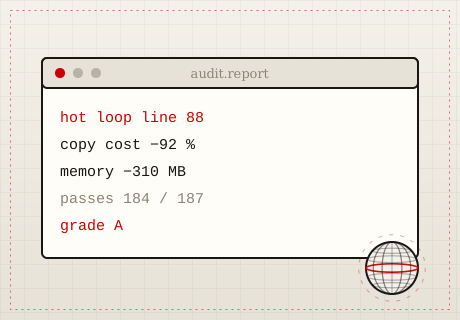
You receive
- Written report, 20–30 pages
- Ranked backlog with effort estimates
- Before-and-after measurements
- Two fixes, implemented
- A 90-minute walkthrough
£3,600 fixed fee
Typical lead time: 2 weeks
Comparing the five
| Service | From | Lead time | What it is for |
|---|---|---|---|
| Automation & Script Development | from £4,800 per suite |
3–6 weeks | Custom UserTalk suites, scheduled agents and the glue between old systems and new ones. |
| Legacy Migration | from £12,000 per system |
6–14 weeks | Move an object database, a Manila site or a Conversant community into a maintainable form. |
| Secure Hosting & TLS | from £340 per month |
1–2 weeks to onboard | Run Frontier or Radio behind modern https, with monitoring, backups and someone on call. |
| Training & Workshops | £2,400 per cohort of 12 |
scheduled monthly | Cohort workshops that leave your team able to read, change and ship the system themselves. |
| Code Audit & Optimisation | £3,600 fixed fee |
2 weeks | Profiling, string and memory work, and a written report you can act on without us. |
The shape of an engagement
Conversation
Thirty to sixty minutes. What the system does, who depends on it, what worries you. Free, and often enough on its own.
Written scope
Deliverables, exclusions, price band, dates and the assumptions we are making. You approve it before anything starts.
The work
A weekly written update with what moved, what did not, and anything that changes the estimate. No surprises at the end.
Handover
Source, documentation, a recorded walkthrough and thirty days of questions answered at no charge.